


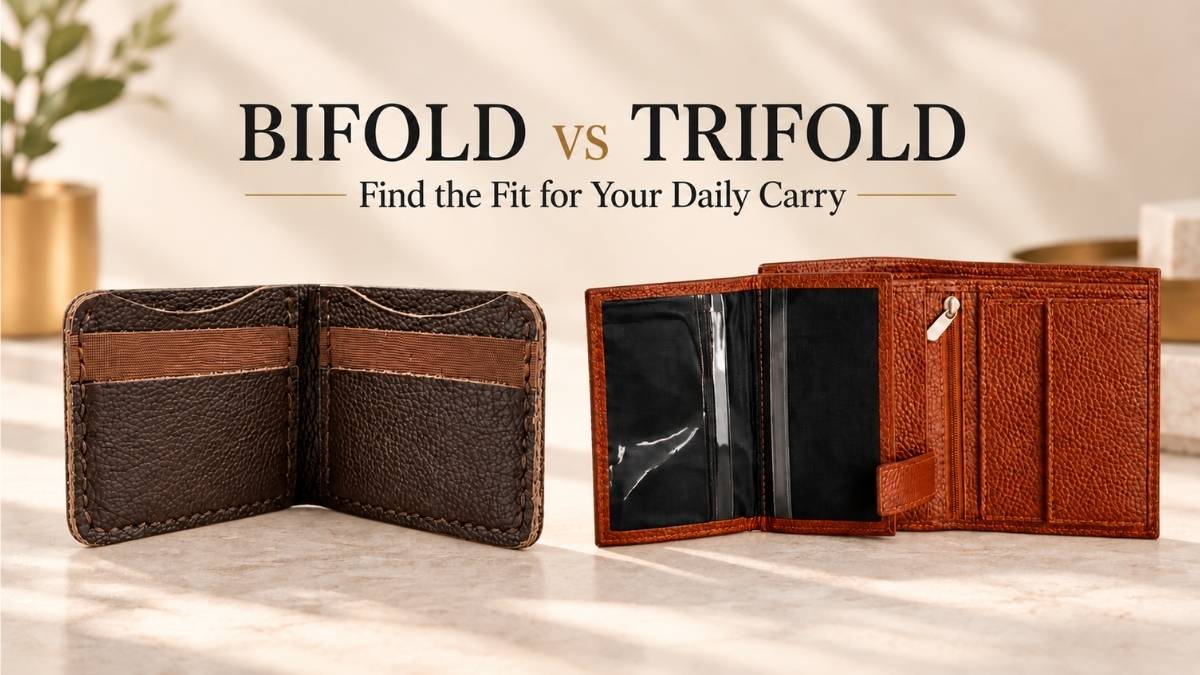
The bifold vs trifold wallet choice starts with what you carry every day. Does your wallet fit comfortably in your pocket? Can you find your CNIC quickly? Is there room for the cards and cash you actually use?
The bifold vs trifold wallet decision comes down to how much you carry and how you want to carry it. A bifold opens into two sections and usually offers a flatter, simpler layout. A trifold opens into three sections and often gives you more places to organize your essentials. Neither design is automatically better. The right one should make your daily routine easier.
This guide compares both styles and helps you choose a wallet that suits daily life in Pakistan.
Choose a bifold if you prefer a relatively slim wallet, carry a modest number of cards, and want to see your essentials as soon as you open it. Choose a trifold if you need separate spaces for more cards, an ID window, receipts, or extra small items, and you are comfortable with a thicker folded wallet.
Folds do not guarantee capacity. A bifold with a coin pocket can be bulkier than a simple trifold. Compare the actual pockets and closed size of individual products.
| What matters in daily use | One-fold bifold | Three-panel trifold |
|---|---|---|
| How it opens | Two sections spread out at once | Three sections unfold in sequence |
| Pocket feel | Commonly wider and flatter | Commonly narrower with more stacked layers |
| Finding a card | Main slots are visible after one fold | Slots may be divided across several panels |
| A good match for | A small set of daily essentials | Cards and documents you prefer to separate |
| Check before buying | Whether it has enough dedicated pockets | Whether the added thickness feels comfortable |
A bifold folds once, like a small book. Inside are usually card slots and a compartment for currency notes. Some models add an ID window, a coin pocket, or a zipper.
With one central fold, a bifold offers quick access to a bank card or CNIC. If you mostly use digital payments but carry a few notes, a straightforward bifold may be enough.
For an ID window, see Supply Junction’s Grey ID Bifold. For a compact design with a zipper and six card slots, see the Field Zip Wallet.
A trifold has three connected panels that fold over one another. The extra panel can make room for additional card slots, an ID window, or a dedicated pocket for smaller items. When closed, the wallet may have a compact footprint, but the stacked panels usually add thickness.
That layout suits people who separate work and personal cards or routinely carry receipts. Extra sections only help when used deliberately: filling every slot can make the wallet uncomfortable.
Supply Junction’s Stone Grey Trifold has card slots across three panels and a central ID window. The Flap Vault Wallet has a flap closure and an interior zipper pocket. Compare their layouts with what you carry.
The most noticeable difference is often the shape in your pocket. A typical bifold spreads its contents across two panels, so it may feel flatter. A trifold stacks three panels, which can make it feel thicker even when its closed width is smaller. Leather thickness, lining, stitching, closures, and how full you keep the wallet all affect the final profile.
For a trouser front pocket, fewer layers often feel more comfortable. A jacket pocket or bag gives you more flexibility. If you sit for long periods, an overfilled back-pocket wallet can become distracting. Judge the wallet with your usual cards and notes inside, not empty in a photo.
Before shopping, empty your current wallet onto a table. Set aside the bank cards, CNIC, licence, and work cards you reach for during a normal week. Count that group, then consider how many Pakistani rupee notes you usually keep with you. This gives you a useful minimum capacity without letting forgotten cards decide the size of your next wallet.
If that pile is small, a bifold may be sufficient. For more separation, try a trifold. Check whether each slot takes one card, whether the ID window is separate, and whether a coin pocket reduces space for notes. Overstuffing either style can stretch slots.
Cash users should inspect the note compartment as carefully as the card slots. A full-width compartment may make notes easier to insert and remove, while smaller or divided compartments may require a different folding habit. The best choice depends on the particular wallet and how you handle cash, not just whether it has two or three panels.
For fast access, the simpler bifold layout often has an edge. Open once, and the main cards are in view. This helps when paying at a counter or showing your CNIC.
A trifold offers organization. Assign one panel to payment cards, another to identification, and another to less-used cards. You may need an extra movement to unfold it fully.
A wallet’s shape cannot tell you how long it will last. Inspect its material, stitching around card slots, and edges. A zipper, flap, or snap can secure loose items, but also adds thickness.
Keep leather away from prolonged moisture and direct heat, clear out receipts, and wipe dust with a soft cloth. Follow care instructions for the specific finish; smooth leather cream may not suit nubuck. Do not force extra cards into one slot.
If you do not know the recipient’s habits, a classic bifold is a practical starting point. A trifold may suit someone whose current wallet is packed with cards.
Notice whether they carry coins, how many cards they use, and whether they prefer neutral or bold colours. A thoughtful gift fits their routine.
Use this five-point check before you buy:
Compare two products side by side. Your daily load should decide the winner.
The first mistake is judging an empty wallet. Card slots, notes, and a CNIC change its shape. If you can, test it with the items you carry every day. When shopping online, use the product photos to study the open layout and check the stated dimensions. A compact looking wallet can still feel bulky once filled.
The second mistake is choosing the wallet with the most slots just because it offers more. Unused compartments add layers without improving your routine. If you carry four cards, a simple bifold may be more convenient than a trifold with space you never use. If you carry several cards, choose a trifold only if its arrangement actually makes them easier to find.
Finally, do not overlook the type of closure. A zipper or flap may be useful if you carry coins or loose receipts, but it adds an opening step and can change the feel in your pocket. Decide whether you need that feature before you choose the colour or finish.
Usually, when materials and contents are similar, a bifold has fewer folded layers and can feel slimmer. Actual thickness varies by design, closures, lining, and how many cards you put inside. Compare specific wallets rather than relying on the label.
No. The extra panel often creates room for more slots, but capacity varies widely. Some bifolds include many card slots, while some compact trifolds prioritize an ID window or zipper pocket. Read the slot count and interior layout.
Either can work. Choose a wallet with a suitable ID window or dedicated card slot and a note compartment that fits the cash you usually carry. If quick access matters most, start with a bifold. If you want separate areas for cards and ID, compare trifolds too.
The best front-pocket wallet is the one that stays comfortable with your normal contents. A lightly loaded bifold is often a good fit, but a compact trifold may also work. Check the closed dimensions and avoid overfilling either style.
In the bifold vs trifold wallet comparison, bifold wins for simple access and a potentially flatter carry; trifold wins when its extra panel gives you the organization you need. The details of a specific wallet can change that result. Count your essentials, look closely at the layout, and picture how it will feel in your pocket on an ordinary day.
Explore Supply Junction’s bifold and trifold examples linked above, compare the features that matter to you, and choose the one that makes everyday carry feel effortless.
No account yet?
Create an Account


