


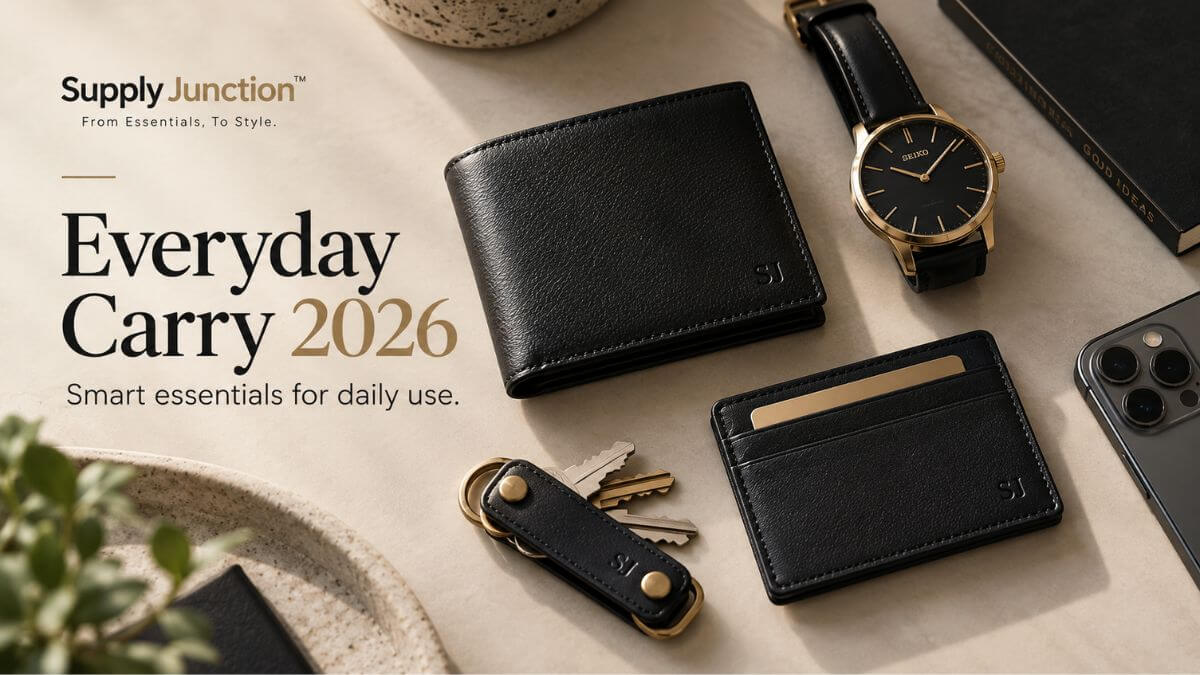
Think about what leaves the house with you every morning.
Your phone. Wallet. Keys. Maybe a watch. Earbuds. A charger. A few cards. A bag if the day demands one.
That collection is your everyday carry, commonly shortened to EDC.
But everyday carry in 2026 is becoming less about filling every pocket with gadgets and more about making deliberate choices. The useful question is no longer “What else can I carry?” It is:
“Which items genuinely earn a permanent place in my daily routine?”
For most people, the best EDC setup is not tactical or complicated. It is simply a small group of reliable things that make daily life easier.
Here is how to build one.
Everyday carry is the set of items you routinely keep in your pockets, handbag, work bag or backpack when you leave home.
There is no universal EDC checklist.
A photographer may carry batteries and storage cards. A business professional might carry a wallet, watch, notebook and laptop accessories. Someone who spends most of the day moving around may prioritise a small crossbody bag, power bank and cardholder.
The point is not conformity.
The point is utility.
A useful rule for 2026 is:
If an item takes up space every day, it should solve a problem regularly.
So before buying anything new, empty your pockets and bag.
Put everything on a table.
You may be surprised by how much you carry without actually using.
The wallet remains one of the most basic everyday-carry items, but the right type depends heavily on how you actually use money.
Ask yourself:
If your daily carry is mostly cards and identification, a slim cardholder may be enough.
If you regularly carry cash, cards and receipts, a conventional bifold or longer wallet may make more sense.
The mistake is buying the smallest wallet possible and then overfilling it.
A minimalist wallet only stays minimalist if your habits support it.
Supply Junction shoppers can compare our current men’s wallets and cardholders and choose based on layout, dimensions and actual daily needs rather than appearance alone.
A good wallet should disappear into your routine. You should not have to reorganise it every morning.
For many people, the smartphone has absorbed several objects that once occupied separate pockets.
It may already handle:
That makes the phone arguably the most important part of modern everyday carry.
The problem is that once everything depends on one device, battery life becomes part of EDC planning too.
You probably do not need a large collection of cables.
A better setup is one compact charger or cable arrangement that supports the devices you genuinely use.
The principle is simple:
Consolidate where possible.
Open your wallet and count your cards.
Then ask how many you used during the last seven days.
Many people carry old membership cards, expired cards, receipts and miscellaneous paper simply because they were never removed.
An everyday-carry reset can take less than five minutes.
Keep:
Remove what does not need to travel with you.
This one adjustment can make even an ordinary wallet feel significantly slimmer.
If your carry has become mostly card-based, consider moving from a full wallet to a cardholder.
That is not about following a minimalist trend. It is simply matching the accessory to the job.
A smartphone tells the time perfectly well.
So why carry a watch?
Because a watch serves a different purpose.
Checking your wrist is faster and less distracting than unlocking a phone, where one notification can easily turn a two-second time check into several minutes of scrolling.
A watch also works as part of personal style.
This is where EDC and fashion intersect.
A clean everyday watch can move easily between:
For Supply Junction, this matters because everyday carry does not have to look technical.
It can be functional and well presented.
Choose a watch that works with the clothes you actually wear rather than one designed for a lifestyle you rarely live.
Keys are one of the oldest everyday-carry problems.
One key becomes three. Three become six. Then receipts, old tags and unnecessary keyrings get attached to them.
The result is noise, bulk and scratched phones.
Start by removing keys you do not use regularly.
If you carry several keys, a compact organiser or simple keyring arrangement can keep them together.
Again, the goal is not to buy equipment for the sake of organisation.
The goal is to eliminate friction.
Your EDC should make leaving home easier, not give you another system to maintain.
One genuinely useful development in modern EDC is item tracking.
Small trackers can help locate keys, bags and other important belongings through compatible device networks.
Apple integrates item tracking through its Find My ecosystem, while Android users have access to Google’s Find Hub ecosystem for compatible devices and trackers.
If you routinely misplace your keys or travel with a bag containing valuable items, a tracker can make more sense than another decorative accessory.
But do not add one to every object you own.
Prioritise:
The principle remains the same: solve an actual recurring problem.
Wireless earbuds are now a legitimate everyday essential for many people.
They handle:
But there is little value in carrying multiple sets unless your work genuinely demands them.
One dependable pair with adequate battery life is usually enough.
The best everyday carry is often boring in the best possible way.
You know exactly where everything is, and everything works.
Not every day requires a bag.
That is important.
A common mistake is designing an EDC around the capacity of a bag rather than designing the carry around the day.
For a short outing, you may need only:
phone + wallet + keys
For work:
phone + wallet + keys + charger + notebook + laptop
For travel, the list changes again.
If your daily essentials exceed comfortable pocket capacity, then a handbag, crossbody bag or work bag becomes useful.
The right bag should provide enough organisation without tempting you to fill every compartment.
Supply Junction’s everyday handbags are one example of how carry can remain functional while still looking appropriate for work, shopping or social use.
Do not choose the largest bag simply because it offers more space.
Unused capacity often becomes clutter.
Minimalism does not mean being unprepared.
Depending on your routine, one or two small contingency items can earn their place.
Examples might include:
The important distinction is between preparedness and accumulation.
If you have carried something for six months and never used it, ask whether it still deserves permanent EDC status.
There is no “perfect” everyday carry.
A student’s carry should not look like a sales executive’s.
A commuter’s carry will differ from someone who works from home.
Someone travelling through airports needs different things from someone stepping out for coffee.
Instead of copying an influencer’s pocket dump, build around three questions:
These are your core essentials.
This identifies genuinely useful additions.
This is where you reduce clutter.
That third question is usually the most valuable.
For many people, a practical starting point is surprisingly short:
Core essentials
Depending on your routine
Your own setup may require only a few of these items, and that is completely fine.
Your goal should be the smallest setup that comfortably handles your normal day.
That is the real direction everyday carry is taking in 2026.
Less clutter.
Better organisation.
More deliberate purchases.
Functionality should come first, but that does not mean everyday objects have to look purely utilitarian.
Your wallet, watch, handbag and accessories are visible parts of how you present yourself.
A coordinated carry can look deliberate without looking overly matched.
For example:
Choose colours and finishes you will still enjoy using after the trend cycle changes.
This also reduces the temptation to constantly replace functional items just for novelty.
Every few weeks, lay out everything you normally carry and review what is still worth keeping with you.
Remove:
Then rebuild from what you actually need.
It takes minutes.
And it stops your supposedly “minimal” everyday carry from slowly becoming portable storage.
The best lesson from everyday carry 2026 is not about one wallet, watch, gadget or bag.
It is about intention.
Carry the things that solve real problems.
Remove the things that add weight without adding value.
Choose accessories that work with your routine and your personal style.
For one person, that may mean nothing more than a phone, cardholder and keys.
For another, it may include a work bag, notebook, charger, earbuds and watch.
Both can be excellent EDC setups.
The difference is whether every item has a reason to be there.
If you are refining your own daily setup, start with the accessories you touch most often. Explore Supply Junction’s wallets and cardholders or browse Supply Junction for fashion and lifestyle essentials built around everyday use.
From Essentials, To Style.
EDC is short for everyday carry, a term used for the practical items someone routinely keeps with them while moving through the day, from phones and wallets to keys and other personal necessities.
A practical setup often starts with a phone, wallet or cardholder, keys and possibly a watch.
You can then add items such as earbuds, charging accessories, a suitable bag or a tracker when your lifestyle actually justifies them.
For many people, yes. Even with digital payments, physical identification, bank cards and cash may still need to be carried. The better question is whether you need a full wallet or only a slim cardholder.
Start by removing duplicate, expired or rarely used items. Keep only the things that solve recurring daily needs, and choose smaller alternatives when they perform the same job just as well.
Only when your daily essentials exceed comfortable pocket capacity. A bag should support your routine rather than encourage you to carry unnecessary items.
No account yet?
Create an Account


